
Last updated November 17, 2026
 Metal roofing
 Architectural shingles
 Tile roofing
 GAF
 Owens Corning
 Flat & low-slope
Free roof inspection with deck photos before we talk money - GAF and Owens Corning certified installation
Roofing Emergency Preparedness Guide for Winchester Homes
Most Winchester homeowners think a roofing emergency is a winter problem. In this valley, it isn’t. Winchester averages roughly 4 inches of rain a year, and the bulk of it lands in a six-week window between July and September. That means your roof spends about ten months bone dry, never tested, and then faces a monsoon cell that can drop an inch of rain in an hour. The failure almost never comes from the rain itself. It comes from everything the dry months hid: a lifted shingle, a cracked pipe boot, a hairline flashing gap that never had a reason to leak. This guide covers what to do when the storm hits, how to tarp and document correctly, how to tell a one-off failure from a dying roof, and the four inspections to finish before July 1 so most of these emergencies never happen.
Quick Answer
Roofing emergencies in Winchester cluster around monsoon season, and most are preventable with a pre-season inspection and a few hundred dollars of repair. When a leak starts during a storm, your priorities are in this order: get a correct tarp on the damaged section, document the damage for insurance, then get a professional out to determine whether it’s an isolated failure or a roof that needs replacement. Emergency tarping buys time. It doesn’t fix anything, and it doesn’t stop a roof that’s failing in multiple places.
Styles & brands we work with
- Architectural shingles
- Metal roofing
- Tile roofing
- GAF
- Owens Corning
- Flat & low-slope
Table of Contents
- Why Winchester Roofing Emergencies Cluster Into Monsoon Season
- How to Tarp a Damaged Roof Section Correctly
- What to Document Immediately After a Storm Event
- Isolated Failure or System-Wide Failure? How to Tell
- The Clark County Emergency Contractor Landscape
- Pre-Monsoon Prep: Four Inspections Before July 1
- When to Call a Professional
- Frequently Asked Questions
Why Winchester Roofing Emergencies Cluster Into Monsoon Season
A roof is a system that gets trained by weather. In most of the country, that training is gradual – rain every few weeks keeps sealants flexed, keeps debris washed off, keeps small defects visible as small stains. Winchester doesn’t work that way. Your roof sits through nine or ten dry months, heat cycling every day, then has to perform under a genuine flash-flood event.
That dry stretch is exactly what makes the first big storm dangerous. Sun and heat bake the asphalt in shingles and slowly harden the sealant strips that glue each course down. Thermal movement works nails loose in their holes. Wind during a dry spring dust storm can crease or lift a tab without tearing it. None of these produce a drip, so nothing gets fixed. Then a monsoon cell parks over the valley, and every one of those small openings becomes a water entry point at the same time. In our experience, the calls that flood in after the first real August storm are not usually about catastrophic damage. They’re about roofs that had three or four small vulnerabilities nobody knew about.
There’s a second Winchester-specific factor: how water behaves when it does arrive. Desert soil doesn’t absorb rain the way people expect, and water that sheets off a roof has to go somewhere. The roofing emergencies we see most often involve water that backed up, pooled, or found a weakness at a valley, a wall intersection, or a low-slope transition. Flat and low-slope sections are common on additions and patio covers around Winchester, and those are the first places to fail under a heavy, fast rain event.
What this means practically: the calendar matters more here than in most markets. Your roof’s real test date is somewhere in July or August. Everything you do before that date is what determines whether the test is a passing grade or an emergency.
How to Tarp a Damaged Roof Section Correctly
A tarp’s only job is to shed water off the damaged area until a professional repairs it. Done right, it buys you days or weeks of protection. Done wrong, it can trap water against the deck, tear off in wind, or create a new leak path where none existed. Tarping is not a repair, and it never substitutes for one.
Before anything else: a roof in active rain, wind, or lightning is not a safe place to be. Wet shingles are slick, and a fall from a one-story roof is a serious injury. If the storm is still happening, stay off the roof and manage water from inside with buckets and towels. Tarp once it’s safe and dry.
Here is the correct sequence for a tarp that actually holds:
- Size it generously. The tarp should overhang the damaged area by at least three feet on every side, and it must run past the ridge or up under the course above the damage so water can’t get behind the top edge.
- Run it down-slope, never across. The tarp’s long axis follows the direction water flows. A tarp laid sideways creates a dam and forces water sideways under the shingles, which is worse than no tarp.
- Fasten at the edges, not the field. Secure it with furring strips or cap nails along the perimeter. Nailing through the middle of the tarp punches holes that leak, and it doesn’t hold in wind.
- Protect the ridge and any penetrations. Vent pipes and chimneys poke through the tarp. Wrap them or run the tarp up and over; a tarp that lays flat across a pipe boot will pool water around it.
- Tension it, then check it. A flapping tarp shreds itself and the shingles under it. Pull it snug and check that it drains instead of pooling.
The most common tarp mistakes we see: tarps too small for the damage, tarps nailed flat through the field, tarps that end mid-slope so water runs off the edge and straight down a wall, and tarps left on for months. A tarp is a stopgap measured in days or weeks, not a permanent covering. It also gives moisture a place to sit against the deck, which is why it needs to be replaced with a real repair sooner rather than later.
What to Document Immediately After a Storm Event
Insurance adjusters work from evidence, and the evidence gets harder to collect every day after a storm. Stains dry. Debris gets cleaned up. Damage gets repaired before anyone photographs it, and then the claim gets denied for lack of proof. Document while the damage is fresh, even if you’re not sure you’ll file.
Build a photo sequence that tells a story rather than a pile of random shots:
- Wide shots first. Photograph each elevation of the roof and the exterior of the house from the ground, so an adjuster can orient every close-up to a location.
- Then work in. Close-ups of the specific damage: missing or creased shingles, dents and impact marks, flashing that pulled away, granules collecting at the bottom of downspouts.
- Inside as well as outside. Ceiling stains, sagging drywall, water tracking down walls, wet insulation in the attic. Interior water damage is often the biggest line item, and it’s the first thing homeowners forget to shoot.
- Capture the context. Downed limbs, debris on the roof, the storm itself if it’s still happening.
- Timestamp everything. Most phones record the date automatically, but note the date and time of the storm on a written log too. Adjusters look for a clear timeline between the event and the damage.
What adjusters actually look for: consistent, uninterrupted photo sequences; damage that matches the reported weather (wind-lifted tabs and impact marks line up with a storm, while long-term granule loss and rot don’t); and moisture readings taken close to the event. Keep a written log with dates, times, and what you observed. Don’t clean up or discard damaged materials before you photograph them. And don’t climb onto a wet or damaged roof to get the perfect shot – ground-level and attic photos plus a professional’s inspection photos will carry a claim just as far.
Isolated Failure or System-Wide Failure? How to Tell
This is the question that decides whether you spend a few hundred dollars or several thousand. A single leak after a hard storm usually means one component failed. A roof that leaks in multiple places, or that’s showing failures across large areas, is telling you the emergency repair will only postpone the replacement.
Signs the damage is isolated and repair will hold:
- One leak, and you can trace it to a specific spot – a lifted flashing, a cracked pipe boot, one torn shingle course.
- Shingles around the damage still lie flat, with intact granules and flexible tabs.
- The attic deck under the leak is sound and not soft or stained over a wide area.
- The roof is on the younger side of its service life.
Signs the failure is system-wide and emergency repair won’t solve it:
- Leaks in two or more separate areas after the same storm.
- Shingles that are brittle, curling, or losing granules across large sections – not just at impact points.
- Multiple nails backing out, or sealant strips that no longer hold tabs down.
- Soft decking, sagging areas, or widespread attic staining.
- Flashing that’s failing at several penetrations and walls at once.
Here’s the hard part: an emergency repair is worth doing on a sound roof, and a waste on a failing one. Patching a roof that’s failed system-wide just moves the next leak six weeks down the road. If you’re not sure which situation you’re in, an inspection is what separates the two – and it should come with a straight answer either way. When the evidence points to replacement, you want options across product tiers rather than a single brand pushed by a dealer, which is why we work across GAF and CertainTeed lines (among others) and let the roof and budget drive the recommendation. Repair or replace – we’ll tell you which one you actually need.
The Clark County Emergency Contractor Landscape
After every major rain event in Clark County, a wave of out-of-state crews shows up offering emergency repairs. Some are legitimate and will do honest work. Others knock on doors, ask for a deposit up front in cash, hand you a contract with nothing specific in it, and disappear before the next monsoon. The difference between the two is visible before you sign anything.
What legitimate emergency response looks like:
- A written scope of work with a line-item estimate, before any money changes hands.
- State licensing you can look up, plus proof of insurance and bonding – ask for both.
- A conversation about whether repair or replacement is the right call, not a pitch for the most expensive option.
- One contact, one crew, and a written record of who will do the work and when.
- Someone who will tell you the tarp is temporary and put the actual repair on a schedule.
Storm-chaser warning signs:
- They found you – they knocked on the door unprompted after a storm.
- They want a large deposit up front, often in cash.
- The estimate is verbal, vague, or refuses to list line items.
- They use a local-sounding business name but their address is out of state, or there’s no address at all.
- They won’t put the repair timeline in writing and can’t show proof of licensing or insurance.
- They pressure you to sign on the spot, right after the storm.
None of this is about the weather. It’s about who you let on your roof. A roofing specialist that does repairs, replacements, and inspections only has an incentive to get the diagnosis right; a crew that appears after a storm and vanishes before the next one does not. Ask for the paperwork. A professional will hand it over without hesitating. If you’re in Winchester and need a straight answer on a storm-damaged roof, call (833) 390-2853. We answer 24/7. Fast dispatch from 7am to 7pm, Sunday through Friday.
Pre-Monsoon Prep: Four Inspections Before July 1
Almost every monsoon emergency is a small defect that could have been found in June. If you finish these four inspections before July 1, you’ve eliminated the majority of scenarios that turn a storm into an emergency.
- Roof surface and shingle condition. Walk the roof (professionally) to check for lifted or curled tabs, missing shingles, exposed nail heads, and granule loss. Any shingle that’s already loose will lift under monsoon wind pressure.
- Flashing and penetrations. Check every place the roof meets a wall, chimney, skylight, or vent pipe. Sealant hardens over the dry months, and dried-out flashing is the number-one monsoon leak path. If the sealant is cracked or pulling away, it gets redone before the rain, not after.
- Drainage and low-slope sections. Check gutters, downspouts, valleys, and any flat or low-slope sections. Confirm water has a clear path off the roof. Debris in a valley or a blocked downspout during a heavy event backs water up under the shingles.
- Attic and interior inspection. From inside the attic, look for old water stains, soft or discolored decking, daylight showing through, and moisture around penetrations. Interior evidence often catches a defect the roof surface hides.
Add a fifth if your roof is older or has had problems before: a full professional inspection with photos, so you have a baseline to compare against after the storm. That baseline matters for insurance, and it’s the difference between “my roof leaked” and “here’s the photo from June showing this area was sound and here’s the one from August showing where it failed.”
In our experience, the roofs that come through monsoon season intact are the ones that had somebody look at them in the spring. The ones that don’t are the ones where the first inspection happens after the leak. Catch it before it costs more.
Common Mistakes to Avoid
- Tarping flat, not down-slope. A tarp laid across the slope dams water and pushes it sideways under the shingles. It has to run down-slope and past the ridge to shed water correctly.
- Nailing through the field of the tarp. Perimeter fastening with furring strips holds in wind; nails punched through the middle leak and don’t hold. Use cap nails at the edges only.
- Cleaning up before you photograph. Once debris is gone and damaged materials are discarded, an adjuster has nothing to look at. Photograph first, clean up second.
- Treating a system-wide failure as a one-off. If leaks show up in several places after the same storm, patching one spot won’t fix the problem. That’s a replacement conversation, not a repair call.
- Hiring the first crew that knocks. Storm-chasers show up after major rain, ask for cash up front, and leave before the next event. Ask for licensing, insurance, and a written line-item estimate.
- Leaving the tarp on for months. A tarp keeps moisture against the deck and hides active damage. It’s a stopgap for days or weeks, not a permanent fix.
- Skipping the pre-season inspection. Doing nothing from October to June is how a small defect becomes a monsoon emergency. The dry months are when problems are cheap to fix.
See the difference
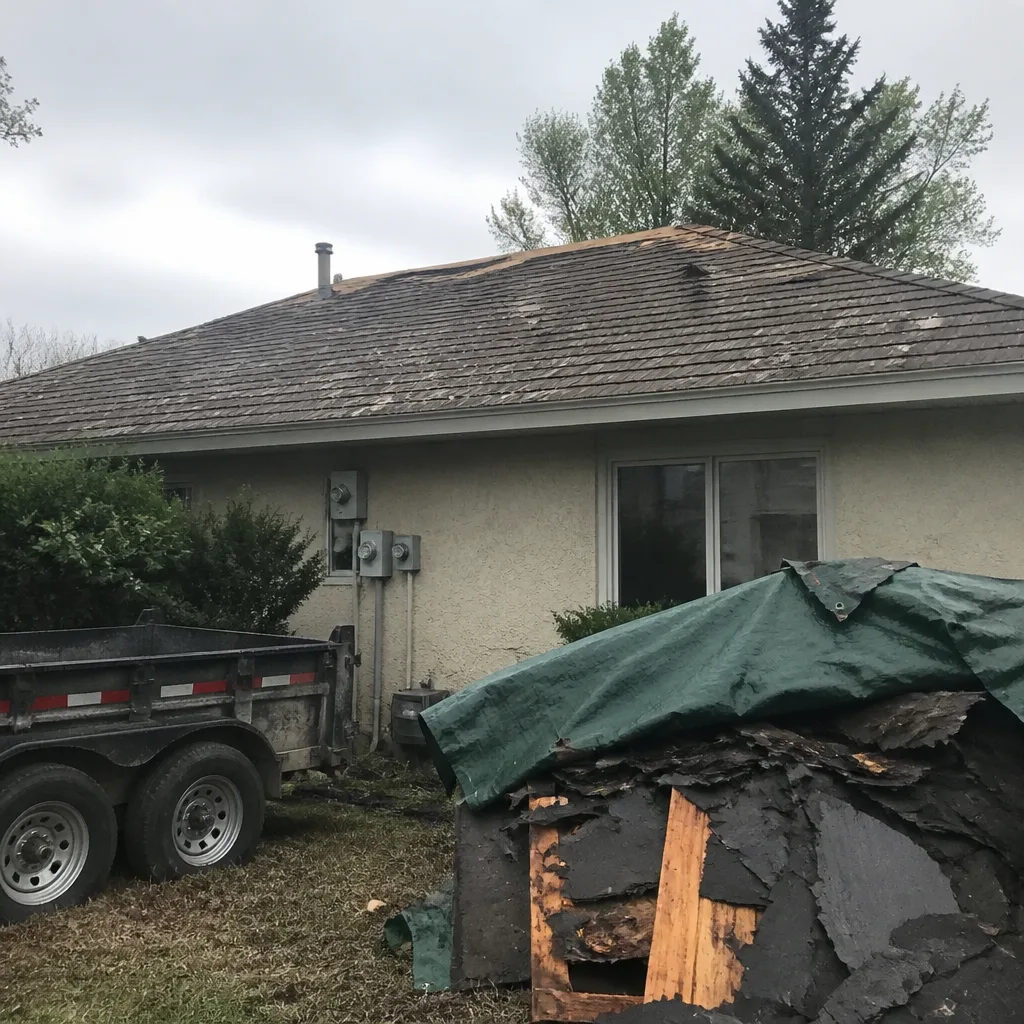 Before
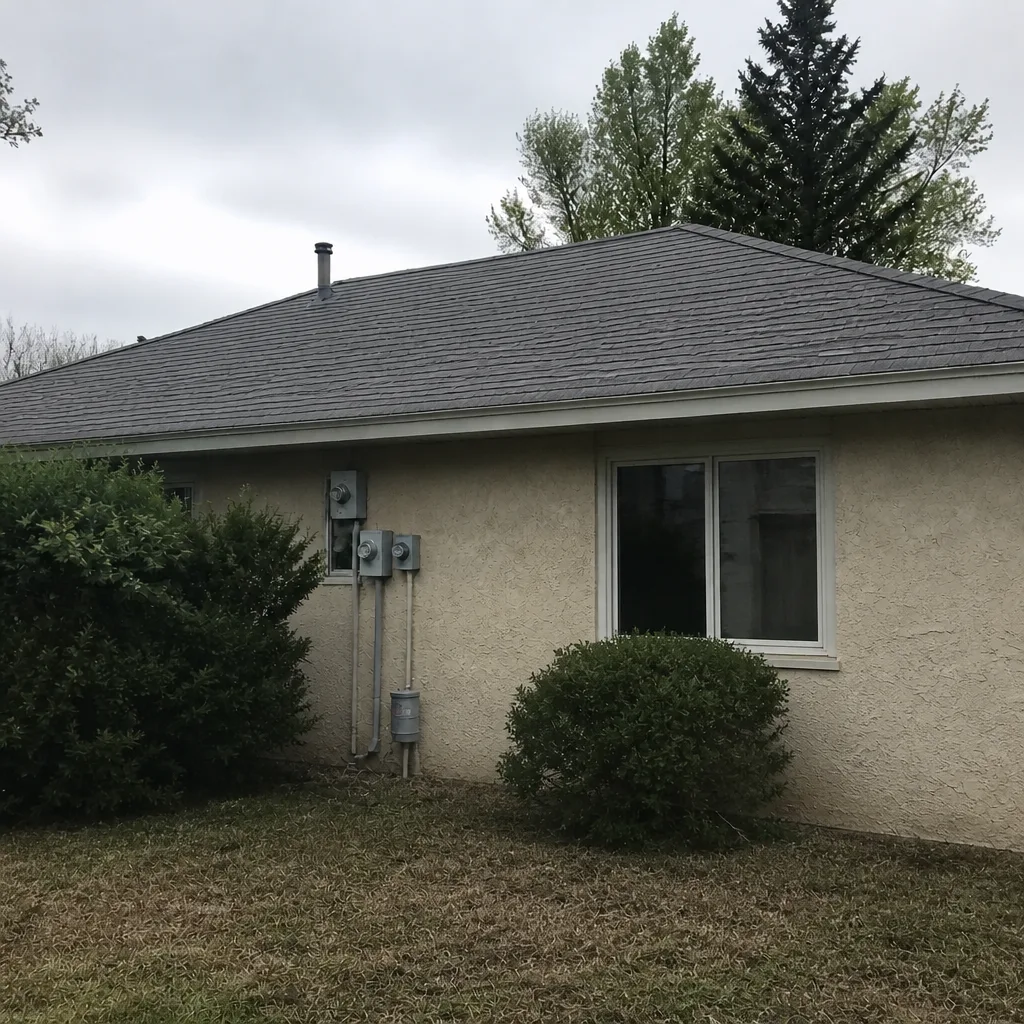 After
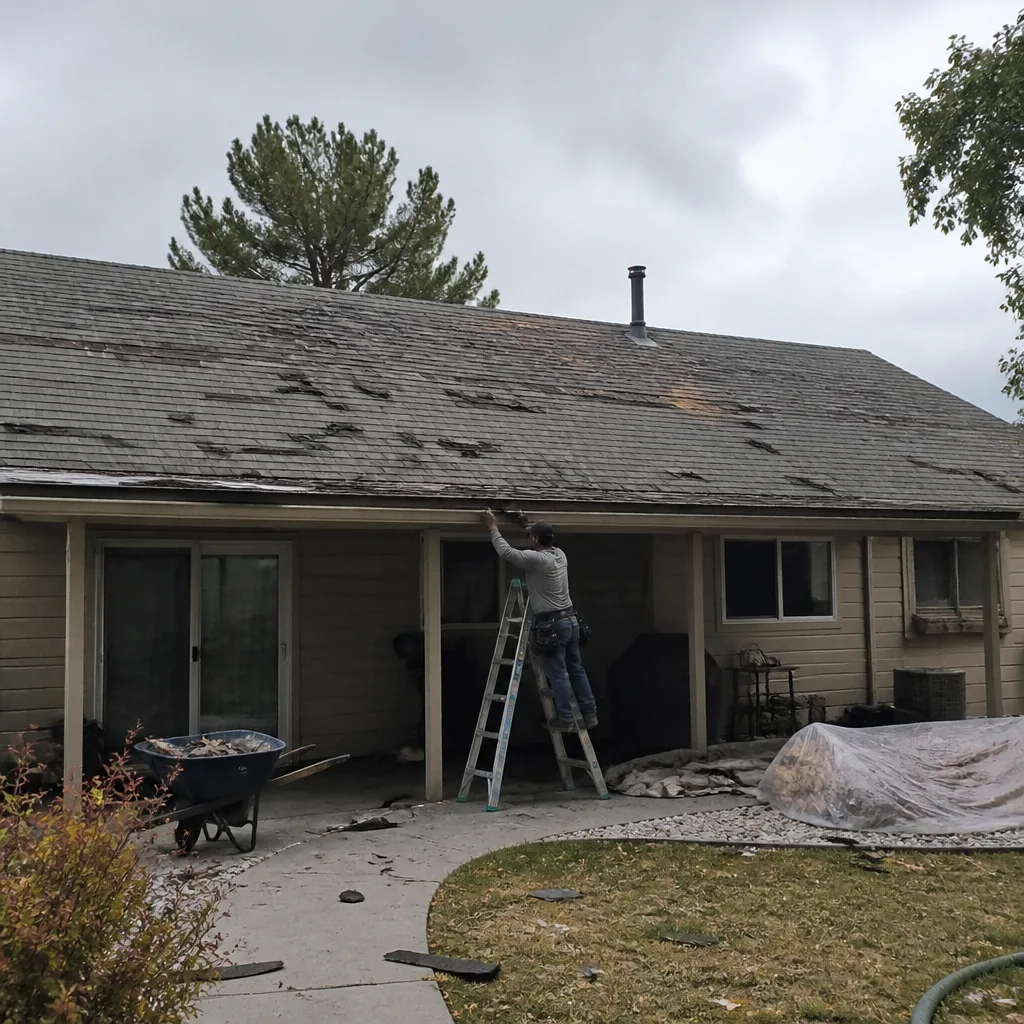 Before
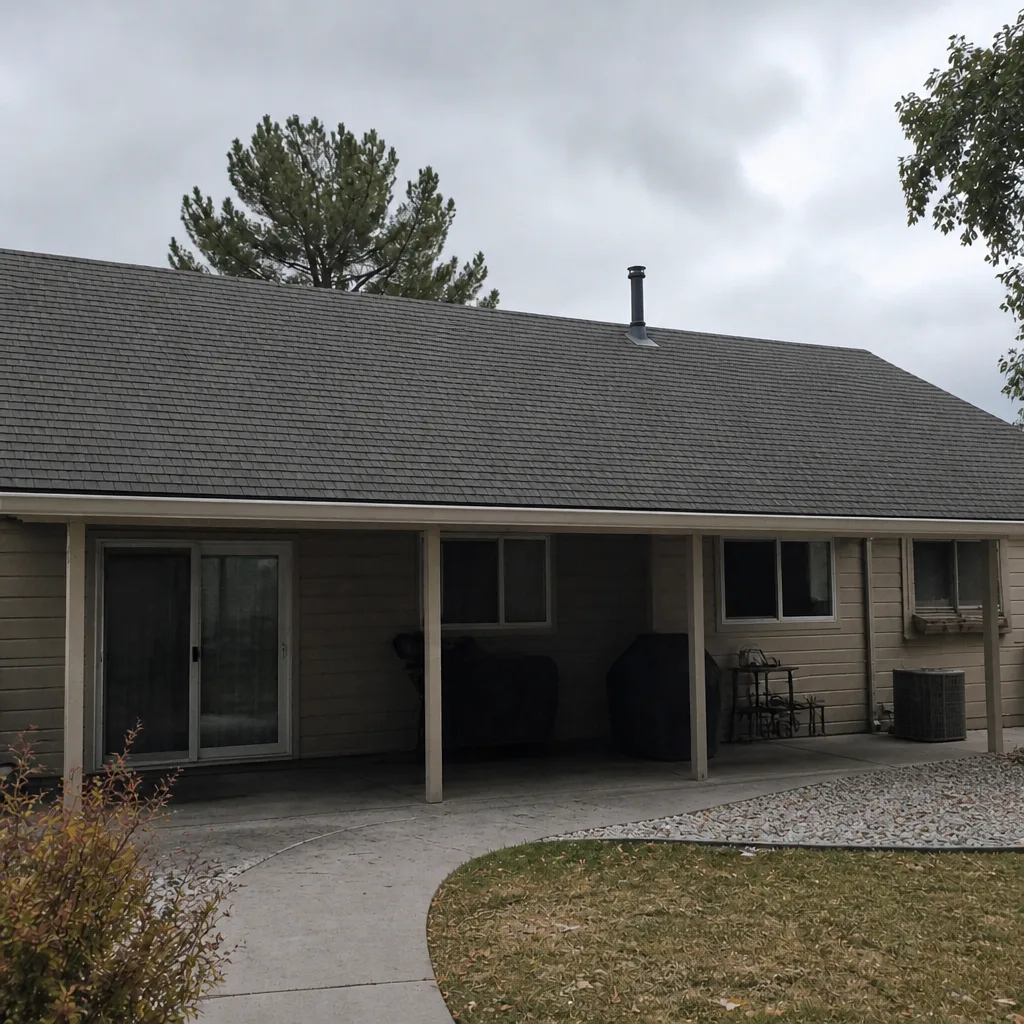 After
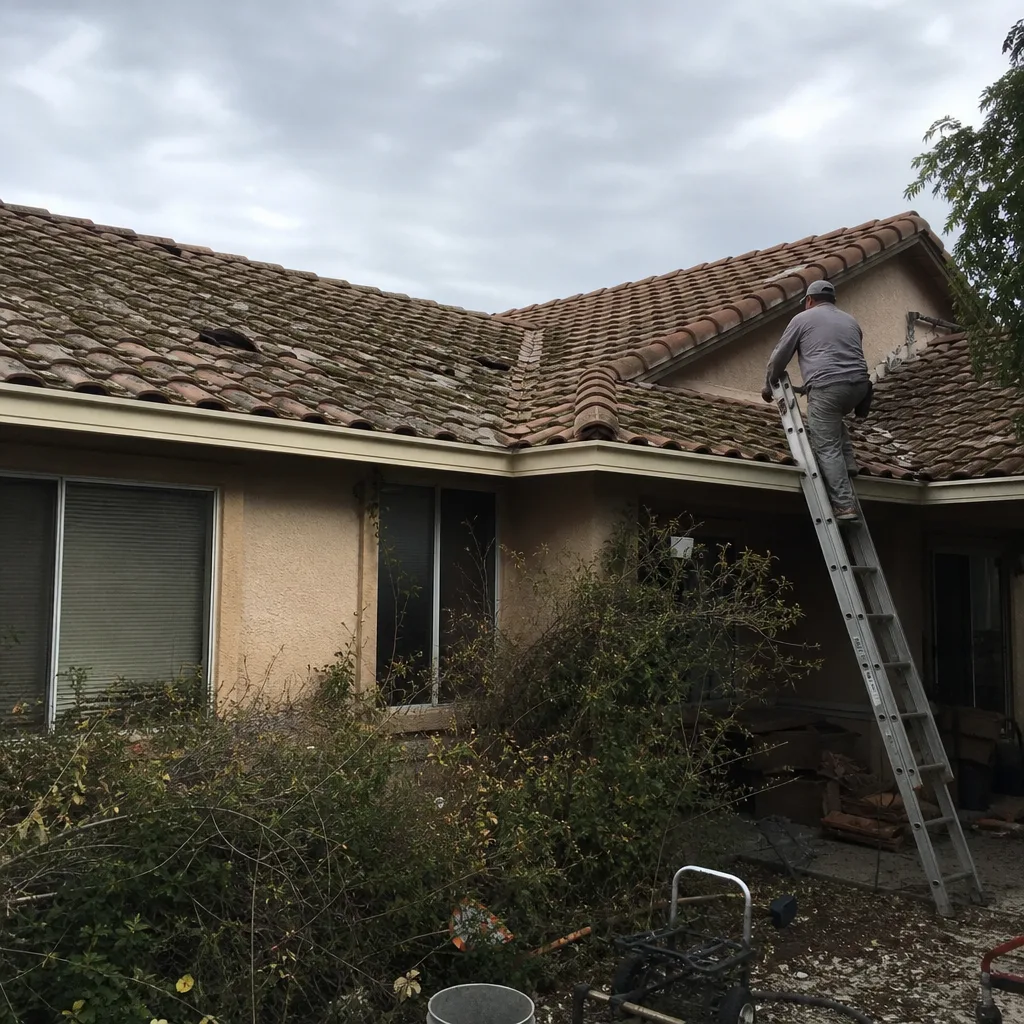 Before
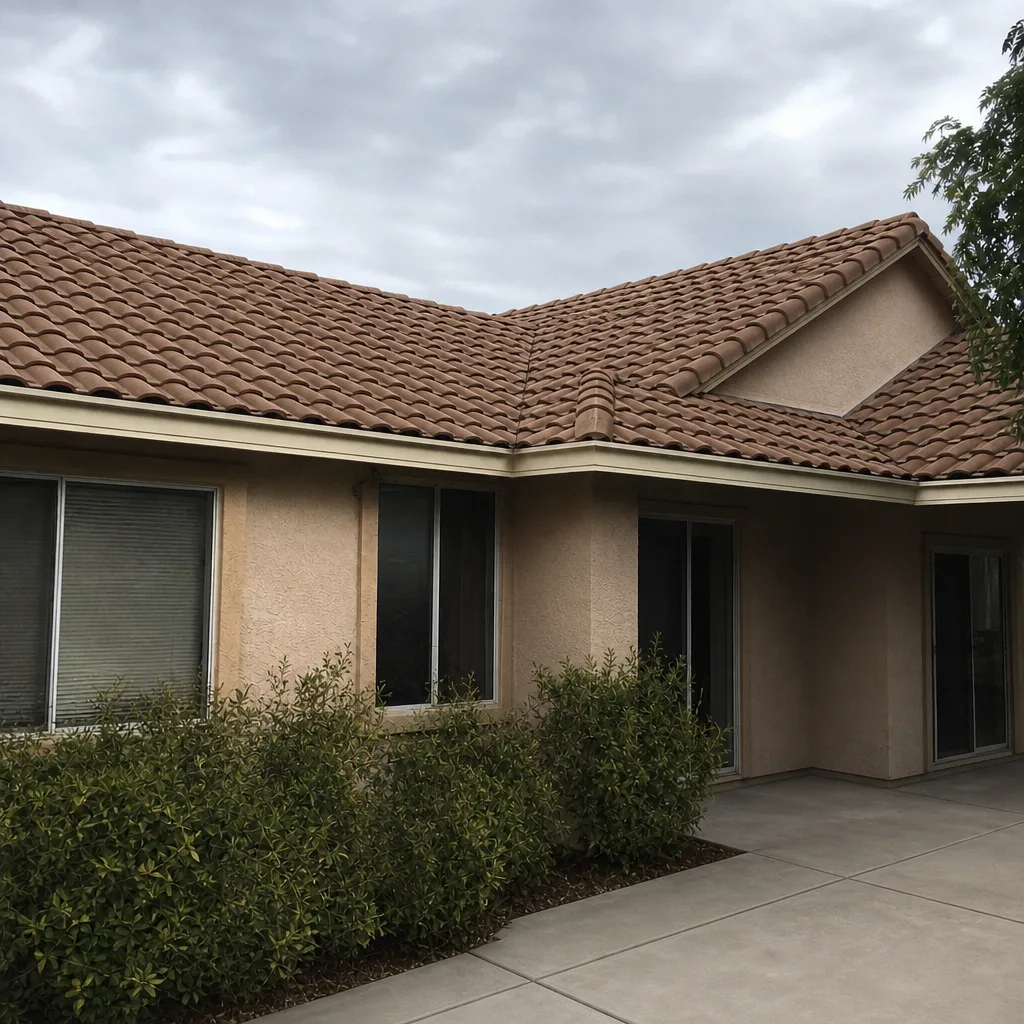 After
When to Call a Professional
Call a professional when there’s active water coming in during a storm, when you’re not sure whether a damaged area is safe to walk on, or when more than one area of the roof is leaking at once. Call when you’ve tarped and the water is still getting in, when you find soft decking or sagging, or when an insurance claim hinges on documentation you’re not equipped to collect safely. And call before July if your roof hasn’t been inspected in a while – a pre-monsoon roof inspection is the cheapest emergency prevention there is. Roofer Winchester offers free estimates in Winchester – call (833) 390-2853. We answer 24/7. Fast dispatch from 7am to 7pm, Sunday through Friday.
Frequently Asked Questions
Get water managed inside with buckets and towels first and stay off the roof until the storm passes – wet, active storms are not safe for roof work. Once it’s dry and safe, get a correctly installed tarp on the damage and start documenting. Then call (833) 390-2853 for a free estimate.
We price every job from a written estimate after we see the roof, so we won’t quote a number sight unseen. What we will tell you is that repair versus replacement is a real question after a monsoon event, and the scope of work decides the price – not the weather. Call (833) 390-2853 for an exact quote – estimates are free.
Whether a claim is covered depends on your policy and how the damage occurred – sudden storm damage is treated differently than long-term wear. Document immediately with wide shots, close-ups, interior photos, and timestamps, and keep a written log. A professional inspection with photos gives an adjuster what they need; call (833) 390-2853 to get the roof documented.
One leak traced to one component is usually a repair; leaks in several separate places after the same storm usually point to a roof that’s failed system-wide. Brittle, curling shingles, widespread granule loss, and failing flashing at multiple points all push toward replacement. An inspection settles it – repair or replace, we’ll tell you which one you actually need. Call (833) 390-2853.
No. A tarp is a temporary covering measured in days or weeks, and leaving it on holds moisture against the deck and hides active damage. It sheds water for now but doesn’t fix the roof, and the damage underneath keeps growing. Call (833) 390-2853 to get the repair scheduled and the tarp replaced with a real fix.
Four: the shingle surface for lifted or missing tabs and exposed nails, all flashing and penetrations for dried or cracked sealant, drainage and low-slope sections for clear water paths, and the attic for stains and soft decking. Finishing all four before July 1 removes most of the scenarios that cause monsoon emergencies. Call (833) 390-2853 to book the inspection.
The Bottom Line
Winchester roofing emergencies are predictable, and that’s the whole point. The 4 inches of annual rain that lands mostly in a six-week window means your roof gets one hard test a year, and everything you do before that test decides the outcome. Tarp correctly when it happens, document thoroughly for insurance, and be honest with yourself about whether you’re looking at one failure or a failing roof. Hire on paperwork, not on a knock at the door. Most important, get the four inspections done before July 1 – because the cheapest monsoon emergency is the one that never happens.
Written by the team at Roofer Winchester.